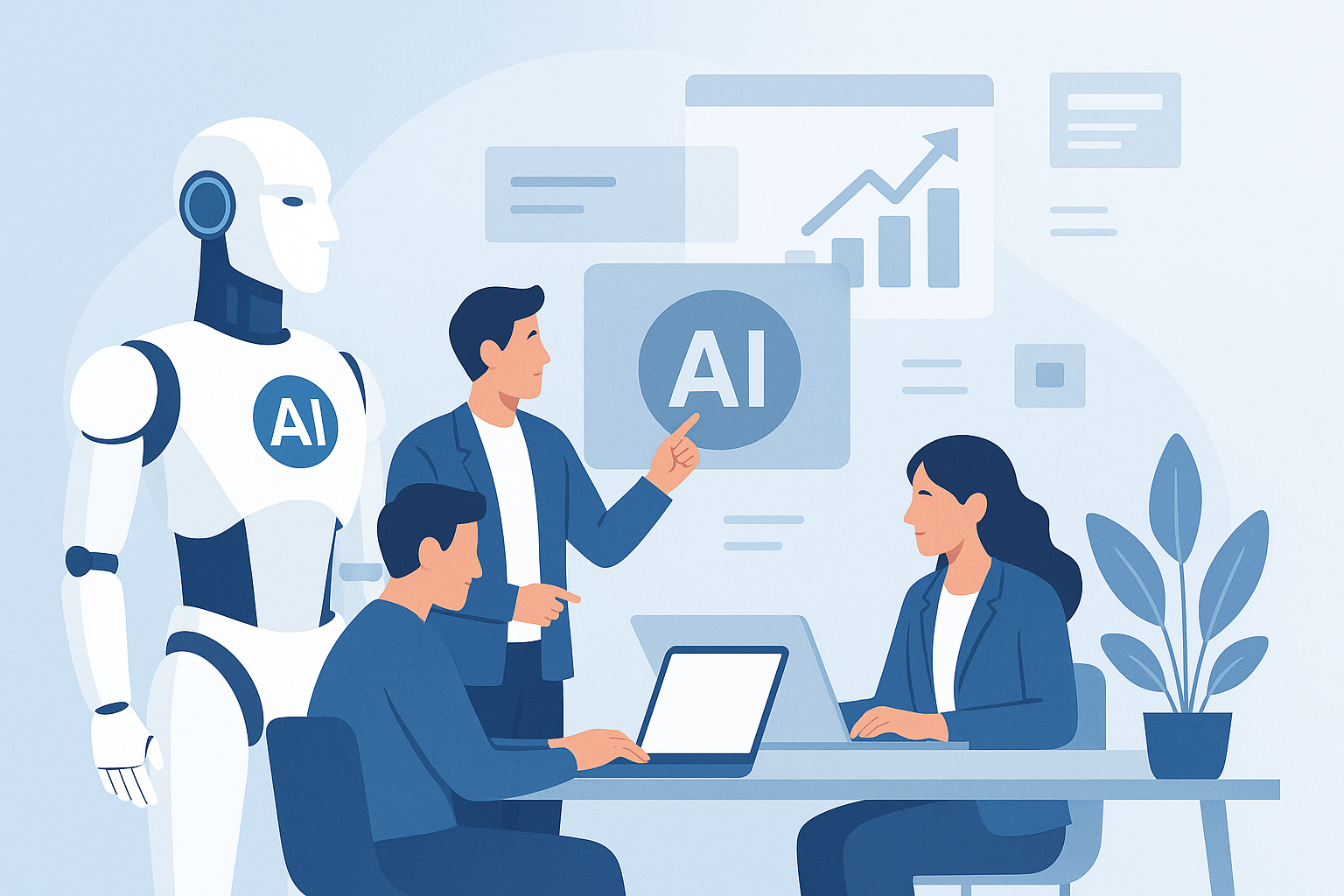
How to Use Artificial Intelligence Workforce for Companies for Startups
Short opening: Startups must move fast, conserve runway, and differentiate. Deploying an AI workforce - a blend of models, automation, and human-in-the-loop processes - helps small teams scale capabilities without linear headcount growth. This guide explains what an AI workforce is, why startups should adopt it, and precisely how to use artificial intelligence workforce for companies for startups with step-by-step execution, KPIs, common pitfalls, recent advances, and an example implementation.
1. What an AI workforce is and why startups should adopt it
Definition: An AI workforce combines AI models (LLMs, vision, speech, predictive models), RPA/automation, integrations, and human oversight to perform knowledge work and repetitive tasks-customer support triage, content generation, insight extraction, code scaffolding, sales outreach, and more.
Benefits & impact
- Business value: Faster time-to-market and improved decision velocity by automating routine work and surfacing insights.
- Cost and time savings: Replace or augment repetitive tasks to reduce cost-per-task and reallocate human resources to high-use work.
- Competitive advantage: Personalization at scale, faster experimentation, and data-driven feature prioritization.
Example stat: startups that automate routine operations often report 20-40% productivity uplift in targeted teams within 3-6 months.
2. Step-by-step execution: 8 practical steps to build an AI workforce
The following eight steps provide a clear, executable roadmap for founders, product leaders, and engineering managers to implement and scale an AI workforce.
-
Step 1 - Assess needs and strategic fit
Actionable tasks: map current processes, identify high-volume/repetitive tasks, quantify time spent, and estimate automation ROI.
Recommended tools: process-mapping tools (Miro, Lucidchart), time-tracking data (Harvest, Toggl), stakeholder interviews.
Timeline: 1-2 weeks
Roles & responsibilities: CEO/Head of Product sets priorities; Ops/Product Manager runs assessment; Engineering/AI lead provides technical feasibility input.
-
Step 2 - Select high-impact use cases
Actionable tasks: score use cases by impact vs. complexity (quick wins vs. long-term bets), choose 1-3 pilot use cases.
Recommended tools: ICE scoring spreadsheets, JIRA for tracking, lightweight prototyping tools (Figma for UI flows).
Timeline: 1 week
Roles: Product lead prioritizes; Customer Success or Sales identifies customer-facing wins; Data lead validates data availability.
-
Step 3 - Choose models, platforms & tooling
Actionable tasks: decide between managed APIs (e.g., Google Vertex AI, OpenAI), open-source models, or custom models; evaluate cost, latency, and privacy needs.
Recommended tools: Vertex AI, Google Cloud tools, Hugging Face, LangChain, RPA platforms (UiPath, Automation Anywhere), serverless infra (GCP Cloud Run).
Timeline: 1-3 weeks (pilot setup)
Roles: CTO/Engineering lead selects stack; DevOps secures infra; Legal flags compliance constraints.
-
Step 4 - Define roles, workflows & human-in-the-loop processes
Actionable tasks: map where humans review AI outputs, create escalation rules, define SLAs, and create role-based access controls.
Recommended tools: workflow orchestration (Airflow, Temporal), ticketing (Zendesk, Jira), approval UIs (internal dashboards).
Timeline: 2 weeks
Roles: Product manager designs workflows; Team leads define approval gates; UX designs human-AI interfaces.
-
Step 5 - Data preparation, privacy & governance setup
Actionable tasks: inventory data sources, create data labeling rules, anonymize PII, define retention policies, and apply encryption.
Recommended tools: BigQuery, Cloud Storage, Dataflow, DLP tools (Google Cloud DLP), labeling (Labelbox), MLOps (MLflow, Vertex Pipelines).
Timeline: 2-6 weeks depending on data complexity
Roles: Data engineer builds pipelines; Security/Legal ensures compliance (GDPR, CCPA); Data steward documents lineage.
-
Step 6 - Build a pilot (MVP)
Actionable tasks: implement an end-to-end MVP for one or two use cases, instrument metrics, collect qualitative feedback, and refine prompts/models.
Recommended tools: LangChain or Vertex AI for orchestration, lightweight front-end (React), monitoring (Prometheus, Grafana).
Timeline: 4-8 weeks
Roles: Engineering builds; Product runs pilot; Customer-facing teams test and provide feedback.
-
Step 7 - Measure, iterate, and scale
Actionable tasks: analyze KPIs (see next section), improve model prompts or retrain, automate previously manual review steps progressively, document SOPs.
Recommended tools: experimentation platforms (Optimizely, internal feature flags), model monitoring (WhyLabs, Fiddler), CI/CD for models.
Timeline: Continuous; 1-3 months per iteration
Roles: Data scientist optimizes models; Product measures impact; Ops prepares scale infrastructure.
-
Step 8 - Governance, compliance, and ongoing operations
Actionable tasks: establish model governance board, bias and safety checks, incident response, cost controls, and periodic audits.
Recommended tools: policy docs, access logs (Cloud Audit Logs), cost monitoring (Cloud Billing), governance frameworks (NIST, internal playbooks).
Timeline: Governance established in 4-8 weeks, then ongoing
Roles: Legal and Security lead governance; Executive sponsor enforces accountability; Team leads own operational metrics.
3. KPIs: how to measure an AI workforce
Primary metrics, formulas, cadence, benchmarks, and dashboarding recommendations:
- Productivity uplift (%) = (Baseline output per person - New output per person) / Baseline output per person × 100. Measure: weekly; baseline: 0-8 weeks pre-pilot; benchmark: 20-40% uplift for automated tasks in 3 months.
- Cost per task = Total cost of AI infra + human review / Number of tasks processed. Measure: monthly; benchmark depends on task complexity (e.g., <$1 for simple triage).
- Accuracy / Quality = Correct outputs / Total outputs. Measure: daily during pilot; target: 90%+ for high-stakes tasks; track drift.
- Time-to-delivery = Average time from task creation to completion. Measure: continuous; target: 30-60% reduction for automated tasks.
- Adoption rate = Active users using AI tools / Total target users. Measure: weekly; target: 60-80% within 8-12 weeks post-launch.
- ROI = (Monetized benefits - Costs) / Costs. Measure: quarterly; include labor savings, revenue lift, and reduced churn where applicable.
Dashboard suggestions: build a centralized dashboard (Looker, Data Studio, Grafana) showing trendlines for productivity uplift, cost per task, accuracy, latency, adoption, and drift alerts. Include drill-downs per team and use case.
4. Common implementation mistakes to avoid
Avoid these frequent pitfalls when learning how to use artificial intelligence workforce for companies for startups:
-
Over-automation too quickly
Cause: eagerness to cut costs. Mitigation: keep human-in-the-loop gating, run staged automation, validate quality before removal of human checks.
-
Poor data hygiene and ignored labeling
Cause: underestimating data complexity. Mitigation: invest in data pipelines, labeling standards, and small-scale labeling first.
-
No clear success metrics
Cause: measuring vanity metrics. Mitigation: define primary KPIs (productivity, cost per task, accuracy) and instrument them before the pilot.
-
Choosing the wrong model or tooling
Cause: picking shiny tech over fit-for-purpose tools. Mitigation: evaluate latency, cost, privacy, and integration needs; run A/B tests.
-
Ignoring governance and compliance risks
Cause: assuming models are safe by default. Mitigation: involve legal/security early, implement PII redaction, and keep audit logs.
-
Failing to change organizational processes
Cause: expecting AI to drop into existing workflows unchanged. Mitigation: redesign processes to incorporate AI outputs, provide training, and update SOPs.
5. Recent AI advancements and practical implications (including Google updates), plus a short case study
Recent advancements and how they change the playbook
Recent developments from major providers such as Google have several implications:
- Improved multimodal models and Vertex AI: Google’s investments in multimodal models and Vertex AI simplify deploying models that handle text, images, and audio-enabling richer AI workforce tasks like visual QA and document understanding without building complex stacks.
- Edge and on-prem capabilities: Newer deployments support lower-latency inference and stronger data control, meaning startups with privacy-sensitive data can process locally or in private clouds.
- Model monitoring and MLOps: Better tooling for drift detection and automated retraining reduces operational overhead and makes scaling safer.
Implication: prioritize managed platforms that support MLOps and multimodal capabilities when selecting tooling in Step 3 to reduce build-time and operational risk.
Short case study: AI workforce for a startup SaaS support team
Context: A B2B SaaS startup with 25 employees had a support backlog and slow SLAs. They implemented an AI workforce to triage incoming tickets and draft recommended responses.
- Steps followed: assessment (2 weeks), pilot on top 3 ticket types (6 weeks), iterative model prompt tuning and human review (8 weeks), scale to 70% of tickets in production (next 3 months).
- Results: 40% reduction in time-to-first-response, 30% fewer full-time support hours required, accuracy held at 92% with human review on edge cases.
- Key learnings: invest in taxonomy and quick-feedback loops; maintain human review for ambiguous cases; monitor drift in ticket patterns after product releases.
Recommendations for next steps
- Start with a focused pilot on the highest-frequency, lowest-risk process.
- Use managed MLOps platforms to shorten time-to-value and ensure observability.
- Document SOPs for human-in-the-loop flows and assign clear ownership for governance.
Call to action: Consider exploring an AI workforce assessment with a partner experienced in startup implementations such as atiagency.io.
SEO and content logistics
Internal linking ideas: link this post to your product pages on AI strategy, case studies, engineering services, and resources such as "AI governance checklist" or "Vertex AI implementation guide".
Recommended word-count distribution (target 1,500 words):
- Introduction & definition: 150-200 words
- Benefits & impact: 150-200 words
- Step-by-step execution (8 steps): 600-700 words
- KPIs & dashboards: 200-250 words
- Common mistakes + advancements + case study + next steps: 200-300 words
SEO note: the target keyword "how to use artificial intelligence workforce for companies for startups" appears naturally throughout the post; use this exact phrase in H1 and in the first 100 words for optimal relevance.
Conclusion
Implementing an AI workforce is a strategic lever for startups to scale operations, accelerate product development, and deliver personalized customer experiences while conserving headcount. Follow the eight-step playbook: assess needs, prioritize use cases, choose the right models and tools, define human-in-the-loop workflows, secure and prepare data, pilot, measure and scale, and establish governance. Track core KPIs and avoid common pitfalls like over-automation and weak data practices. Recent platform advances (including Google's Vertex AI and MLOps improvements) lower the barrier to entry - but success still depends on disciplined execution and clear ownership.
For founders and technical leaders figuring out next steps, consider a focused pilot and governance plan and engage experienced partners to accelerate safely. Consider exploring assistance from atiagency.io to design and operationalize your AI workforce strategy.