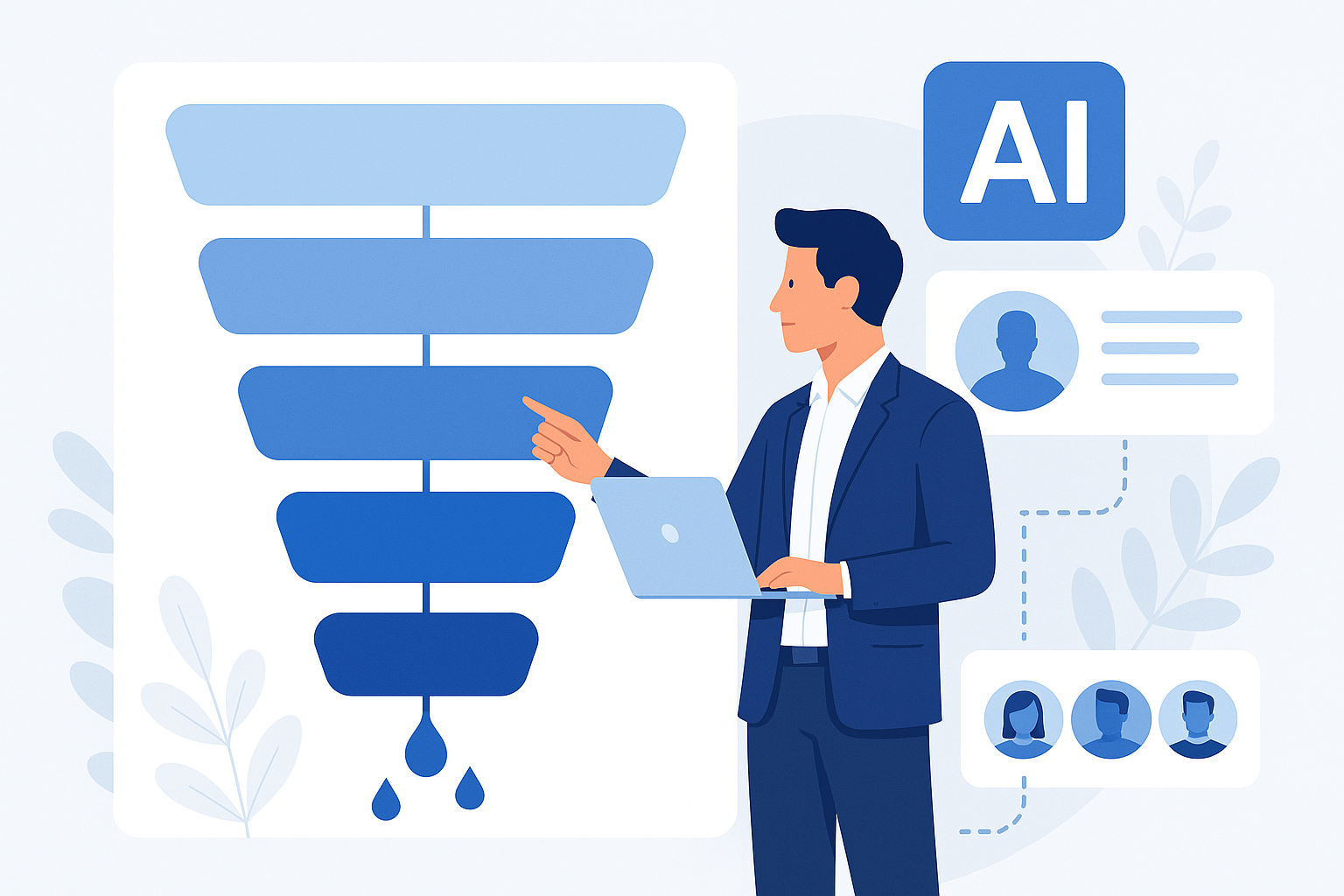
How to Use B2B Pipeline Generation with Artificial Intelligence for Sales Teams
Introduction: Why AI-driven B2B pipeline generation matters for sales teams
Artificial intelligence is transforming how B2B sales teams build, qualify, and accelerate pipeline. For revenue leaders and sales operations, AI-driven B2B pipeline generation replaces guesswork with data-driven prospecting, predictive prioritization, and automated orchestration that preserves personalization at scale. Learning how to use B2B pipeline generation with artificial intelligence for sales teams is no longer optional - it’s a competitive advantage that improves conversion rates, shortens sales cycles, and increases predictable revenue.
This guide walks through a step-by-step execution plan, KPIs and benchmarks, common implementation mistakes and how to avoid them, recent Google AI updates that impact pipeline generation, a short case example, a recommended tech stack checklist, and a concise action plan with next steps and a clear CTA to engage atiagency.io for expert support.
Step-by-step execution: Implementing AI-driven B2B pipeline generation
Below is a pragmatic, numbered implementation plan your sales and revenue ops teams can follow to deploy AI for pipeline generation successfully.
-
Step 1 - Preparation: data, stakeholders, and success criteria
- Assemble stakeholders: Sales leadership, SDR/BDR managers, RevOps, marketing, legal/privacy, and IT.
- Audit data sources: CRM (opportunities, activities), marketing automation, engagement signals (email, site, content), third-party intent and firmographic data.
- Define target profiles & ICP: Firmographics, technographics, buying triggers, and ideal customer signals for different segments.
- Set success criteria: target increase in qualified leads, conversion lift, pipeline velocity, and acceptable CAC impact.
-
Step 2 - Model selection and vendor evaluation
- Decide between build vs. buy: Build if you've mature ML/data science; buy if you need speed and packaged integrations.
- Evaluate capabilities: predictive scoring quality, support for RAG (retrieval-augmented generation), integration with your CRM, model explainability, and security/compliance.
- Ask vendors for: sample model outputs on your anonymized data, precision/recall metrics, latency, and SLAs for model updates.
- Proof of concept (PoC): Run a 6-8 week PoC with control and test groups to validate lift before a full rollout.
-
Step 3 - Integration into CRM and sales workflows
- Embed predictive scores: Surface AI scores, next-best-actions, and risk flags directly in opportunity and lead records.
- Automate but preserve human judgment: Use AI to prioritize and recommend, not to close decisions without human review for complex deals.
- Design workflow triggers: e.g., create tasks when a high-fit prospect exceeds a score threshold, or alert account owners when intent signals spike.
- Audit trails: Ensure each AI recommendation includes context (why it was recommended) and a timestamp for governance.
-
Step 4 - Campaign orchestration and personalization at scale
- Orchestrate outreach: Use AI to sequence personalized emails, ads, and SDR touches based on intent and stage.
- Dynamic content: Generate or adapt messaging blocks for specific verticals, personas, and pain points while maintaining brand guardrails.
- Multichannel alignment: Coordinate paid, organic, and sales outreach so the same signals drive consistent messaging across channels.
-
Step 5 - Monitoring, iteration, and model governance
- Continuous monitoring: Track model drift, scoring distribution, and performance by cohort.
- Feedback loops: Push closed-won and closed-lost outcomes back to the model to retrain and improve accuracy.
- Governance: Maintain version control, approval workflows for model updates, and a roll-back plan if performance degrades.
-
Step 6 - Change management and adoption
- Train the sales organization: Run workshops that show how AI scores map to actions and which objections AI helps resolve.
- Measure adoption: Monitor how often reps act on AI recommendations and tie usage to outcomes.
- Iterate playbooks: Update call scripts, email templates, and objection handling based on what the AI surfaces.
Key KPIs for AI-driven pipeline generation (benchmarks & measurement)
To evaluate success, measure a combination of velocity, conversion, quality, and cost metrics. Below are the most important KPIs, how to calculate them, and suggested benchmarks to aim for.
-
Pipeline velocity: (Number of opportunities × average deal value) / average sales cycle length.
Benchmark: 10-20% increase in velocity in the first 6 months is a realistic initial goal for AI-enabled programs.
-
Lead-to-opportunity conversion rate: Opportunities / MQLs.
Benchmark: Aim for a 15-30% relative lift after AI scoring and prioritization improvements.
-
Qualified leads per month: Count of leads meeting AI-defined qualification criteria.
Benchmark: Depends on segment; look for improved quality over raw volume - higher intent leads with similar or slightly lower volume.
-
Customer acquisition cost (CAC): Total sales & marketing spend / new customers.
Benchmark: Target a reduction in CAC as outreach becomes more efficient - 10-25% is achievable if AI improves targeting.
-
Predictive scoring accuracy: Precision@K, AUC-ROC, or lift vs. random baseline.
Benchmark: Precision lift of 20-50% over rule-based segmentation is a strong indicator of a good model.
-
Engagement metrics: Email open/reply rates, meeting accepts from AI-prioritized leads.
Benchmark: Expect open/reply lift of 2x for hyper-personalized sequences generated from intent signals.
Measurement tips: use cohort analysis (by campaign, segment, or model version), maintain control groups during PoCs, and automate dashboards that combine CRM and engagement data for real-time monitoring.
Common implementation mistakes and how to avoid them
Many B2B organizations trip up during AI deployments. Below are the most frequent mistakes and practical ways to prevent them.
- Poor data quality: Garbage in, garbage out. Fix by standardizing and deduplicating CRM records, enriching firmographic data, and ensuring event timestamps are accurate.
- Over-automation: Automating decisions that require human judgment reduces deal health. Avoid by using AI for ranking and recommendations, not unilateral actions on critical opportunities.
- Ignoring change management: Reps may mistrust or ignore AI. Solve with training, transparent explanations for AI decisions, and incentives aligned to using AI recommendations.
- Poor model governance: No version control or rollback plans lead to risk. Implement clear governance: model registries, retraining schedules, and performance SLAs.
- Neglecting privacy and compliance: Ensure consent and lawful processing of personal data; involve legal and security teams early.
Recent Google AI advancements and practical takeaways for pipeline generation
Google’s progress in large language models (LLMs) and Vertex AI tools has direct relevance to B2B pipeline generation. Notable areas include the Gemini/PaLM families, improved multimodal capabilities, and enhanced tooling for retrieval-augmented generation (RAG) via Vertex AI.
- Retrieval-augmented generation (RAG): Makes AI responses grounded in your proprietary CRM and knowledge bases, improving relevance for prospect-specific outreach.
- Multimodal models: Enable analysis of documents, meeting transcripts, and product sheets to enrich lead profiles and automate insight extraction.
- Vertex AI integration: Simplifies deployment, monitoring, and MLOps for models - practical for teams that want managed infrastructure and model governance.
- Practical takeaway: Use RAG to connect your CRM + content library to the model so AI-generated messages and recommendations are based on the latest, company-approved assets and deal context.
"Use modern LLMs with retrieval and governance rather than raw generative output to ensure accuracy and compliance."
Implementation example, recommended tech stack, concise action plan, and CTA
Mini case study: SaaS vendor shortened sales cycle by 28%
A mid-market SaaS company implemented an AI scoring model integrated into their CRM, coupled with RAG-driven email personalization. By prioritizing accounts showing intent (third-party intent signals + site behavior) and routing high-score leads to senior SDRs, they increased lead-to-opportunity conversion by 22% and shortened average sales cycle by 28% over six months. Key drivers were quality data, clear playbooks for SDRs, and weekly model retraining with closed-won feedback.
Recommended tech stack / tools checklist
- CRM: Salesforce, HubSpot, or similar with API access
- Data warehouse: BigQuery, Snowflake, or equivalent
- Model & MLOps: Vertex AI, AWS Sagemaker, or managed vendor platform
- Intent & enrichment providers: Bombora, 6sense, Clearbit (or equivalents)
- Engagement & automation: Outreach, Salesloft, Marketo, or HubSpot workflows
- Orchestration & RAG: Vector DB (Pinecone, Weaviate) + LLM with RAG support
- Analytics & BI: Looker, Tableau, or Power BI for KPI dashboards
Concise action plan / next steps (30-90 days)
- Day 0-14: Stakeholder alignment, data audit, and ICP definition.
- Day 15-45: Run a vendor PoC or internal prototype with a small sales cohort and a control group.
- Day 46-75: Integrate outputs into CRM workflows, create playbooks, and begin training reps.
- Day 76-90: Measure initial KPIs, iterate model thresholds, and scale to other segments if the PoC meets defined success criteria.
Consider engaging atiagency.io for strategy alignment, PoC design, and hands-on implementation support to accelerate results while ensuring governance and adoption.
Conclusion and recommended resources
Mastering how to use B2B pipeline generation with artificial intelligence for sales teams requires a balanced approach: high-quality data, the right model and integrations, transparent governance, and careful change management. When executed correctly, AI boosts pipeline quality, shortens cycles, and delivers measurable ROI. Start with a targeted PoC, monitor the KPIs listed above, avoid common pitfalls, and use modern RAG and MLOps tools to keep AI grounded in your business context.
Recommended resources:
- Internal link ideas: "atiagency.io/services", "atiagency.io/case-studies", "atiagency.io/resources" for internal content mapping and signposting (use as anchor text to your site pages).
- Technical resources: vendor docs for Vertex AI, RAG implementation guides, and CRM API best practices.
If you want expert help aligning AI, data, and sales processes, consider discussing a tailored plan with atiagency.io.